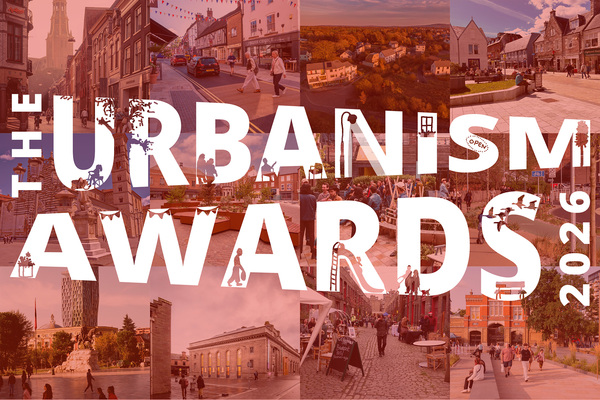
2026 Urbanism Awards finalists announced
Introducing this year's candidates for Great Streets + Spaces, Neighbourhood, Towns / Small City, and European City of the Year


On Friday, 29 April 2026, at the AoU's Shaping a Collective Focus event, held in Dublin, Edinburgh, and London, we launched this year's Urbanism Awards finalists.
This follows a public call for nominations over the winter and shortlisting discussions attended by Academician and Young Urbanist members of the AoU, summarised below. Over the summer, in-person assessment visits will run to each shortlisted place, open to AoU members.
For the list of confirmed assessment dates, visit our Events Directory, or click on any red text below. As more dates are announced for other finalist visits, these will be shared via the AoU's newsletter.
Fort William High Street is an exemplar of how a UK high street can thrive in the 21st Century, and how a BID model can nurture a place to realise its potential.
Stretford Kingsway is an exemplar of how ambitious street redesign can put people first, improve connectivity and encourage active travel. Its transformation has attracted attention as a model for future schemes, described by the Dutch Cycling Embassy as ‘A blueprint for future active travel schemes across the UK’.
Woolwich Town Centre is an exemplar of how reconnecting public spaces can create a more welcoming and people-friendly town centre, bringing Beresford Square and Powis Street together through better seating, reduced clutter and more opportunities to stop, stay and enjoy the surroundings.

Cloughjordan Ecovillage
Co Tipperary

NOMA
Manchester
Cloughjordan Ecovillage: At the heart of Cloughjordan Ecovillage is a community built on care, openness and shared responsibility. From shared farm ownership and open allotment days to an honesty fridge and welcoming community spaces, everyday initiatives bring people together and strengthen connections with the wider village. Rooted in care for both people and planet, Cloughjordan shows how neighbourliness can grow into a resilient, generous and joyful way of life.
NOMA shows how neighbourliness can flourish across a mixed-use development, bringing people together through welcoming public spaces, free workshops, community events and meanwhile spaces. With a generous, inclusive approach that reaches beyond its own boundaries, NOMA demonstrates how a place can create connections and serve the wider community.
Ashbourne is showing what can happen when a town’s future is shaped from the ground up. Through the Ashbourne Reborn project, residents and local businesses have worked alongside the District Council to revitalise the town centre. A strong base of local property ownership has helped nurture a distinctive independent retail scene, with high-quality businesses offering specialist, in-person experiences that draw visitors from across the region.
Gainsborough is breathing new life into its historic heart. From restoring traditional shopfronts and reimagining the Market Place to bringing new uses into historic buildings, the town is reconnecting its heritage with today's needs. A vibrant programme of community-led cultural events is helping turn public spaces into places for people to gather, connect and celebrate.
Perth is showing how culture, heritage and creativity can drive city-centre renewal. The transformation of the historic Edwardian City Hall into Perth Museum, alongside the repositioning of Perth Art Gallery, is attracting visitors and bringing new life to the city centre. Community-led initiatives such as the Bear Trail, featuring sculptures by artists and local schoolchildren, bring joy to public spaces while celebrating local identity and supporting youth programmes. Together, these projects demonstrate how culture can strengthen civic pride and create a more distinctive, welcoming city centre.
Groningen centres its approach around making public space free and accessible.
Free, open public space is a deliberate policy choice. From The Forum and pocket parks to the Akerkhof, converted traffic spaces and city beaches, Groningen creates places where people can meet, sit and swim without paying. This is particularly valuable for groups such as 12–16-year-olds, who are often overlooked in the design of public spaces.
Prato is showing how to use data to deliver targeted environmental investments.
Prato’s Urban Forestry Action Plan combines satellite imagery, around 60 sensors and demographic data to identify where greening is needed most. By focusing on areas facing the greatest heat, pollution and vulnerability, the city makes environmental investment more targeted and effective.
Tirana is putting its citizens’ wellbeing at the heart of urban change.
Over the past decade, Tirana has shifted from car-oriented growth towards people-centred development, placing public space, safe mobility, clean air and everyday proximity at the heart of its urban policies. The results are tangible: the pedestrianisation and greening of Skanderbeg Square, redesigned neighbourhood spaces, reclaimed school streets, 62 km of bicycle lanes and the region’s first protected intersection designed for all ages and abilities.
"The Urbanism Awards are a core part of the AoU experience and a great way to get to know fellow members and learn from place"
All twelve finalists will be assessed by panels of AoU members on in-person visits throughout the summer. Subsequently reports will be compiled and used for voting in the autumn. To join an assessment visit click here, or to find out more about getting involved in the Urbanism Awards this year, contact Connie at [email protected]
Image credits:
Ashbourne - photo courtesy of Ashbourne Town Team
Cloughjordan Ecovillage - photo courtesy of Sustainable Projects Ireland Ltd (SPIL)
Fort William High Street - photo courtesy of BID Fort William
Gainsborough - photo courtesy of West Lindsey District Council
Groningen - photo by Nirmal Suresh via Unsplash
NOMA - photo courtesy of Federated Hermes
Perth - photo courtesy of Perth & Kinross Council © Greg Holmes
Prato - photo by Peter Stenzel via Flickr
Stretford Kingsway - photo courtesy of CIVIC
Tirana - photo by Mario Beqollari via Unsplash
Woolwich Town Centre - photo courtesy of LDA Design © Neil Speakman